
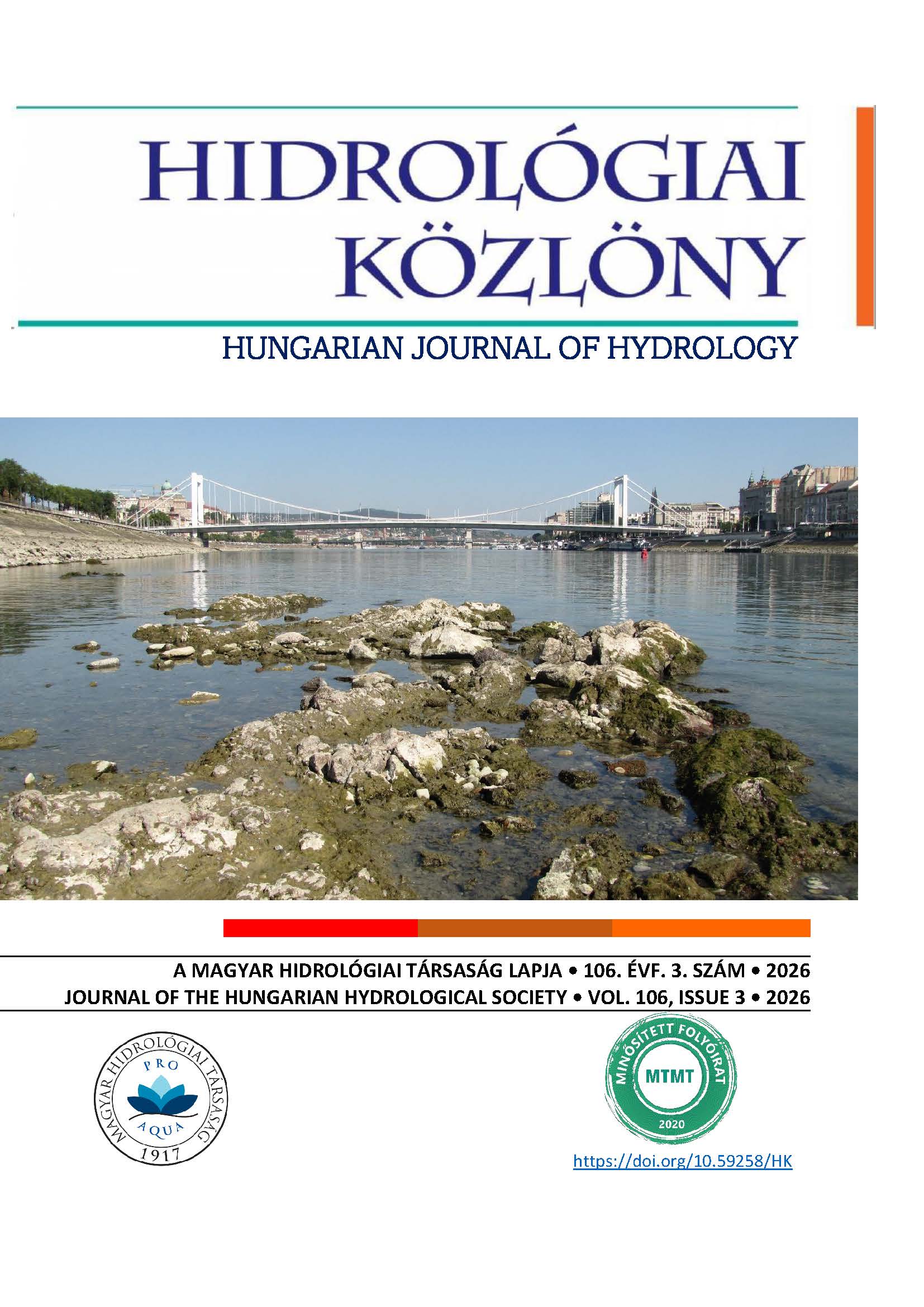
Record low water levels in Hungary: what is happening to our rivers?

Keywords: Danube, small waters, landscape, climate change, Carpathian Basin, Hungary

Abstract

Due to warming, increasing evaporation, extreme precipitation events, and longer dry periods, extreme hydrological events – both low water levels and floods – may become increasingly frequent. The consequences of low water levels are also exacerbated by the deepening of the riverbeds of a significant part of Hungarian rivers which has been going on for decades. This will not happen every year, but the frequency of situations that now seem extreme will increase, so this must be considered at the strategic and planning levels. Restoring the natural behavior of rivers, increasing water retention, transforming landscape use, developing sediment management, modernizing existing technical facilities, or even using new water infrastructures can be complementary tools. The article by János Józsa, Sándor Baranya, and Gábor Timár was written at the request of Mihály Pósfai, President of the Hungarian Academy of Sciences, in the first days of August 2026.

Author Biographies

János Józsa, Budapest University of Technology and Economics, Department of Hydraulic and Water Resources Engineering

JÁNOS JÓZSA  is a civil engineer, Professor, Rector Emeritus of Budapest University of Technology and Economics. Member of the Hungarian Academy of Sciences, President of the Academy’s Section of Engineering Sciences. Main research interest is the hydrodynamics of surface waters including interface processes, measuring and modelling wind-induced lake currents and sediment motion, measuring and modelling flow, mixing and sediment transport in rivers with compound channel, modelling floodplain inundation. Editoral Board member of the Hungarian Journal of Hydrology

Sándor Baranya , Budapest University of Technology and Economics, Department of Hydraulic and Water Resources Engineering

SÁNDOR BARANYA received his Civil Engineering degree from the Budapest University of Technology and Economics (BME) in 2003 and his PhD from the same university in 2010. He is currently the head of the Department of Hydraulic Engineering and Water Management at BME and an associate professor. His research interests include the study of riverbed morphology, flow dynamics, and sediment migration using field methods and computer modeling. He has been a member of the Hungarian Hydrological Society since 2003.

Gábor Tímár, Department of Geophysics and Space Science, Institute of Geography and Earth Sciences Eötvös Loránd University

GÁBOR TIMÁR, Doctor of the Hungarian Academy of Sciences, Head of the Department of Geophysics and Space Sciences at ELTE University of Applied Sciences, deals with riverbed dynamics and strategic issues of landscape water management, among other geophysical and geodetic problems.

References

DanubeSediment Interreg projekt - https://interreg-danube.eu/projects/danubesediment-q2

Danube4all - Restoration of the Danube River Basin for ecosystems and people from mountains to cocást. https://www.danube4allproject.eu/

iNNO SED projekt - https://innosed.eu/

NKFIH MULTI-WATER projekt - https://nkfih.gov.hu/hivatalrol/online-sajto/aszaly-rekordalacsony
Published
2026-09-03
How to Cite
JózsaJ., BaranyaS., & TímárG. (2026). Record low water levels in Hungary: what is happening to our rivers?. Hungarian Journal of Hydrology, 106(3), 4-8. https://doi.org/10.59258/hk.24792
Section
Scientific Papers