Decoupling transport-related CO2 emissions from economic growth: Empirical analysis (2000–2023)
Abstract
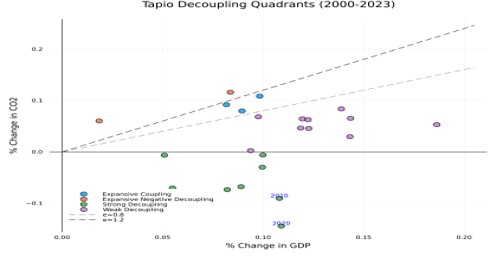
This study investigates the dynamic relationship between economic expansion measured by Gross Domestic Product at Purchasing Power Parity (GDP at PPP) and transport-related carbon dioxide (CO2) emissions in Hungary over the period 2000–2023. Using the Julia 1.10 programming language for high-performance statistical processing, the research employs a three-tier methodology comprising Augmented Dickey-Fuller (ADF) unit root testing, the Tapio elasticity framework, and Pearson correlation analysis of growth rates. The empirical results reveal that although absolute levels of GDP and emissions are non-stationary, their yearly growth rates are statistically independent (r = 0.17, p > 0.05), suggesting a significant break in the traditional carbon-growth nexus. The Tapio analysis identifies a prolonged “Strong Decoupling” phase from 2008 to 2013, followed by a return to efficiency-driven decoupling in 2023. These findings suggest that structural improvements and technological advancements have increasingly superseded economic volume as the primary drivers of transport emissions.
References
Abastante, F., Corrente, S., Greco, S., Ishizaka, A., Lami, I. M. (2019). A new parsimonious AHP Methodology: Assigning priorities to many objects by comparing pairwise few reference objects. Expert Systems with Applications. 127, 109–120. DOI: https://doi.org/10.1016/j.eswa.2019.02.036
Alises, A., & Vassallo, J. M. (2015). Comparison of road freight transport trends in Europe. Coupling and decoupling factors from an Input–Output structural decomposition analysis. Transportation Research Part A: Policy and Practice, 82, 141-157. DOI: https://doi.org/10.1016/j.tra.2015.09.013
Al-lami, A., Török, Á. (2024). Decomposition of carbon dioxide (CO₂) emissions in Hungary: A case study based on the Kaya Identity and LMDI Model. Periodica Polytechnica Transportation Engineering. 53(1), 7–15. DOI: https://doi.org/10.3311/PPtr.37552
Al-lami, A., Török, Á. (2025). Assessing the driving forces of carbon dioxide emissions of the transport sector in Central Europe. Transportation Research Interdisciplinary Perspectives. 31, 101428. DOI: https://doi.org/10.1016/j.trip.2025.101428
Al-lami, A., Török, Á. (2026). Economic growth and transport emissions: Testing the environmental Kuznets curve in Austria and the Netherlands. Transportation Research Procedia. 93, 71–76. DOI: https://doi.org/10.1016/j.trpro.2025.11.011
Apergis, N. (2016). Environmental Kuznets curves: New evidence on both panel and country-level CO₂ emissions. Energy Economics. 54, 263–271. DOI: https://doi.org/10.1016/j.eneco.2015.12.007
Cautisanu, C., Hatmanu, M. (2023). A study of the decoupling of economic growth from CO₂ and HFCs emissions in the EU27 countries. Energies. 16(14), 5546. DOI: https://doi.org/10.3390/en16145546
Dai, S., Zhang, M., Huang, W. (2016). Decomposing the decoupling of CO₂ emission from economic growth in BRICS countries. Natural Hazards. 84(2), 1055–1073. DOI: https://doi.org/10.1007/s11069-016-2472-0
Foster, V., Dim, J. U., Vollmer, S., & Zhang, F. (2023). Understanding the challenge of decoupling transport-related CO2 emissions from economic growth in developing countries. World Development Sustainability, 3, 100111. DOI: https://doi.org/10.1016/j.wds.2023.100111
Gómez, A. P., Bonilla, D., & Banister, D. (2024). Decoupling transport-CO2 emissions: Mexico, Spain and The USA: A trend analysis. Transportation Research Part D: Transport and Environment, 137, 104510. DOI: https://doi.org/10.1016/j.trd.2024.104510
Huang, F., Zhou, D., Wang, Q., Hang, Y. (2019). Decomposition and attribution analysis of the transport sector’s carbon dioxide intensity change in China. Transportation Research Part A: Policy and Practice. 119, 343–358. DOI: https://doi.org/10.1016/j.tra.2018.12.001
Pana Tronca, L. (2025). Climate and transport planning: A messy junction. European Transport Studies. 2, 100025. DOI: https://doi.org/10.1016/j.ets.2025.100025
Sorrell, S., Dimitropoulos, J. (2008). The Rebound Effect: Microeconomic Definitions, Limitations and Extensions. Ecological Economics. 65(3), 636–649. DOI: https://doi.org/10.1016/j.ecolecon.2007.08.013
Szabó, Z., Szalmáné Csete, M., Sipos, T. (2024). Spatial econometric analysis of carbon dioxide emission – European case study. Promet – Traffic & Transportation. 36(2), 193–202. DOI: https://doi.org/10.7307/ptt.v36i2.436
Tapio, P. (2005). Towards a theory of decoupling: Degrees of decoupling in the EU and the case of road traffic in Finland between 1970 and 2001. Transport Policy. 12(2), 137–151. DOI: https://doi.org/10.1016/j.tranpol.2005.01.001