Reframing the sustainability transformation of mobility systems through cognitive sustainability: An integrated perspective on cost structures, decision-making, and emission dynamics
Abstract
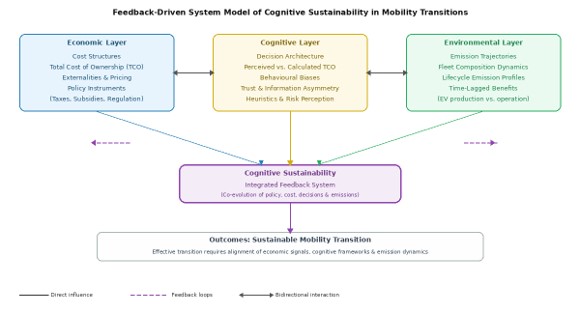
This work reinterprets the sustainability transformation of mobility systems from a cognitive sustainability perspective, integrating economic mechanisms, decision-making processes, and emission dynamics into a unified analytical framework. While traditional approaches emphasise cost structures and policy incentives, this work argues that the transformation cannot be fully understood without considering the cognitive dimension of decision-making. Total cost of ownership (TCO) is positioned as a central mediating construct that not only reflects economic rationality but also serves as a cognitively informed decision interface shaped by perception, trust, and information asymmetry. The analysis highlights that the relationship between costs and emissions is dynamic and non-linear over time, particularly in the case of electrification, where short-term emission increases can precede long-term sustainability benefits. By integrating economic, environmental, and cognitive layers, the study proposes a feedback-driven systems model in which policy instruments, cost structures, user choices, and emission trajectories evolve together. The results show that an effective sustainability transformation depends not only on optimising cost structures but also on shaping the cognitive frameworks through which these costs are perceived and internalised.
References
Campos, V. B. G., Ramos, R. A. R., de Miranda e Silva Correia, D. (2009). Multi-criteria analysis procedure for sustainable mobility evaluation in urban areas. Journal of Advanced Transportation. 43(4), 371–390. DOI: https://doi.org/10.1002/atr.5670430403
Desreveaux, A., Hittinger, E., Bouscayrol, A., Castex, E., Sirbu, G. M. (2020). Techno-economic comparison of total cost of ownership of electric and diesel vehicles. IEEE Access. 8, 195752–195762. https://doi.org/10.1109/ACCESS.2020.3033500
Franzò, S., Nasca, A., Chiesa, V. (2022). Factors affecting cost competitiveness of electric vehicles against alternative powertrains: A total cost of ownership-based assessment in the Italian market. Journal of Cleaner Production. 363, 132559. DOI: https://doi.org/10.1016/j.jclepro.2022.132559
Hariram, N. P., Mekha, K. B., Suganthan, V., Sudhakar, K. (2023). Sustainalism: An integrated socio-economic-environmental model to address sustainable development and sustainability. Sustainability. 15(13), 10682. DOI: https://doi.org/10.3390/su151310682
Hörcher, D., Tirachini, A. (2021). A review of public transport economics. Economics of Transportation. 25, 100196. DOI: https://doi.org/10.1016/j.ecotra.2021.100196
IPCC – Intergovernmental Panel on Climate Change (2023). Climate change 2021: The physical science basis. Working Group I Contribution to the Sixth Assessment Report of the Intergovernmental Panel on Climate Change. Cambridge University Press. DOI: https://doi.org/10.1017/9781009157896
Lerchner, I., Zöldy, M. (2026). Assessment of passenger car electrification by yearly total CO₂ emission. Promet – Traffic & Transportation. 38(5), 1018–1031. DOI: https://doi.org/10.7307/ptt.v38i5.1272
Máca, V., Daňková, A., Jedlička, J., Haitmarová, R. (2011). Economic aspects of transportation. Transactions on Transport Sciences. 4(2), 71–80. DOI: https://doi.org/10.2478/v10158-011-0008-6
Raux, C. (2011). Tradable Permits in the Transport Sector. John Libbey Eurotext.
Wouters, M., Anderson, J. C., Wynstra, F. (2005). The adoption of total cost of ownership for sourcing decisions: A structural equations analysis. Accounting, Organisations and Society. 30(2), 167–191. https://doi.org/10.1016/j.aos.2004.03.002
Zöldy, M., Szalmáné Csete, M., Kolozsi, P. P., Bordás, P., Török, Á. (2022). Cognitive sustainability. Cognitive Sustainability. 1(1). DOI: https://doi.org/10.55343/CogSust.7