A study of the evolution of the city's public policies from the perspective of the mobility of residents in priority neighbourhoods
Abstract
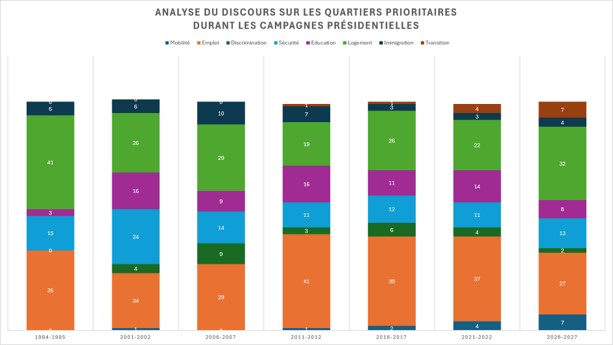
Mobility inequalities in French priority neighbourhoods, or Quartiers Prioritaires de la Politique de la Ville (QPVs), have historically been addressed through transport infrastructure and urban regeneration policies. However, these approaches do not explain the mobility difficulties experienced by residents, which also stem from social, economic and educational inequalities. This paper examines how French public policies addressing mobility in priority neighbourhoods have evolved from an infrastructure-centred approach towards a broader conception of inclusive mobility. It asks to what extent this shift reflects a transformation in the understanding of mobility inequalities. The article combines a historical and policy analysis of urban and transport legislation with a review of academic literature and institutional reports (INSEE, CEREMA, ANRU, ANCT, SYTRAL). It also includes a thematic analysis of French press coverage of priority neighbourhoods using Europresse to identify changes in public debate over time. The analysis shows that mobility remained largely secondary within successive urban policies, which primarily focused on housing renewal, social mix and urban regeneration. Since the 2000s, and particularly following the 2019 Mobility Orientation Act (LOM), public action has progressively incorporated the notion of inclusive mobility through personalised support measures such as mobility advice, social driving schools, cycling schools and community-based initiatives. These innovations recognise that access to transport alone is insufficient without developing residents' mobility capabilities. The paper argues that mobility policies are gradually shifting from an infrastructure-based model towards a capability-oriented approach, although investment in personalised mobility support remains marginal compared with expenditure on transport infrastructure.
References
Avrillier, P., Hivert, L., & Kramarz, F. (2010). Driven out of employment? The impact of the abolition of national service on driving schools and aspiring drivers. British Journal of Industrial Relations, 48(4), 784-807. DOI: https://doi.org/10.1111/j.1467-8543.2010.00813.x
Belot, L. (1996) About a thousand deaths a year would be attributable to car pollution. [in French : Un millier de décès par an seraient imputables à la pollution automobile]. Le Monde. URL: https://www.lemonde.fr/archives/article/1996/06/13/un-millier-de-deces-par-an-seraient-imputables-a-la-pollution-automobile_3728862_1819218.html
Bouzouina, L., Havet, N. et Pochet, P. (2016). Does living in a ZUS affect the daily mobility of workers? An econometric analysis based on the Lyon Household Travel Survey. [in French : Résider en zus influe-t-il sur la mobilité quotidienne des actifs ? Une analyse économétrique à partir de l’enquête Ménages déplacements de Lyon]. Revue économique. 67(3), 551–580. DOI: https://doi.org/10.3917/reco.673.0551
Chamboredon, J-C., Lemaire, M. (1970). Spatial proximity and social distance. Large housing estates and their population. [in French : Proximité spatiale et distance sociale. Les grands ensembles et leur peuplement]. Revue française de sociologie. 11(1), 3–33. Persée. URL: https://www.ecoledurenouvellementurbain.com/wp-content/uploads/sites/8/2014/03/Chamboredon-Lemaire-Proximit%C3%87-sociale-et-distance-sociale.pdf
Debizet, G. (2004). Urban people's movements: from transport planning to sustainable mobility management. Changes in expertise. [in French : Déplacements urbains de personnes: de la planification des transports à la gestion durable de la mobilité]. Géographie, Université de Paris 1 Panthéon Sorbonne. URL: https://theses.hal.science/tel-00006468/file/tel-00006468.pdf
Famy, C., Weiss, S., Prigent, P., Vincent, B., Verchere-Tortel, L., Olivero, C., ... & Pouzet, W. (2008). Eco-Responsible Mobility. [in French: La Mobilité Écoresponsable]. URL: http://www.reperes-dd.org/uploads/media/gl_livret_enseignants_mobilite.pdf
Gallou, R. (2021). Older immigrant women, a population forgotten by public policies. [in French: Les femmes âgées immigrés, une population oubliée des politiques publiques]. Les Cahiers du Développement Social Urbain. 73(1), 17–18. DOI: https://doi.org/10.3917/cdsu.073.0017
Gallois, F., & Nieddu, M. (2015). When the State Declares the Market: The Case of the Borloo Plan. [in French: Quand l’État décrète le marché: le cas du Plan Borloo]. Revue de la régulation. Capitalisme, institutions, pouvoirs, (17).DOI: https://doi.org/10.4000/regulation.11209
Goudie, Douglas (2000) Toward sustainable urban travel: a zonal study of current and future urban travel behaviour, values and preferences of Cairns and Townsville householders. PhD thesis, James Cook University. URL: https://researchonline.jcu.edu.au/967/
Kaufmann, V., Bergman Manfred, M., Joye, D. (2004). Motility: Mobility as Capital. International Journal of Urban and Regional Research. 28. 745–756. DOI: https://doi.org/10.1111/j.0309-1317.2004.00549.x
Kirszbaum, T., Epstein, R. (2010). Synthesis of University Work and Evaluation of Urban Policy. [in French : Synthese De Travaux Universitaires Et D’evaluation De La Politique De La Ville]. URL: https://hal.science/hal-01267393v1/document
Joxe, L. (2022). Mobility Capital: A Bourdieusian Capital? The Experience of Médecins Sans Frontières Members. [in French: Le capital de mobilité : un capital bourdieusien? L’expérience des membres de Médecins sans frontières]. Espaces et sociétés. 184–185(1), 115-130. DOI: https://doi.org/10.3917/esp.184.0115
Lévêque, A. (2019). Serving the suburbs: Metropolization and the relegation of social housing neighborhoods in the Lyon metropolitan area 1959-2019. [in French: Desservir la banlieue: Métropolisation et relégation des quartiers d’habitat social dans l’agglomération lyonnaise (1959–2019)]. PhD thesis. Université Lyon 2. URL: https://theses.hal.science/tel-03483135
Macsinka, K. (2025). Mobility impacts of urban development in the agglomeration. Acta Technica Jaurinensis. 18(4), 172–179. DOI: https://doi.org/10.14513/actatechjaur.00782
Maguer, A., Berthet, J. M., Arrouet, C., & Minet, B. (1997). Public service workers in tough neighborhoods: between performance and social justice. [in French: Les agents des services publics dans les quartiers difficiles: entre performance et justice sociale].
Oppenchaim, N. (2013). The obstacles to mobility for some young people in disadvantaged neighborhoods [in French: Les freins à la mobilités d’une partie des jeunes dans les quartiers sensibles]. Les Cahiers du Développement Social Urbain. 58(2), 18–19. DOI: https://doi.org/10.3917/cdsu.058.0018
Saroli, C. (2015). Passenger transport in rural and sparsely populated areas in France. International Transport Forum Discussion Paper. URL: https://www.econstor.eu/handle/10419/121948
Tánczos, K. (2025). Adapting the ITF's transport policy with a focus on the EU's strategy of sustainable mobility. Periodica Polytechnica Transportation Engineering. 53(2), 222–225. DOI: https://doi.org/10.3311/PPtr.39780