Sustainability comparison of petrol and electric small boats on Lake Balaton: A life cycle and total cost analysis
Abstract
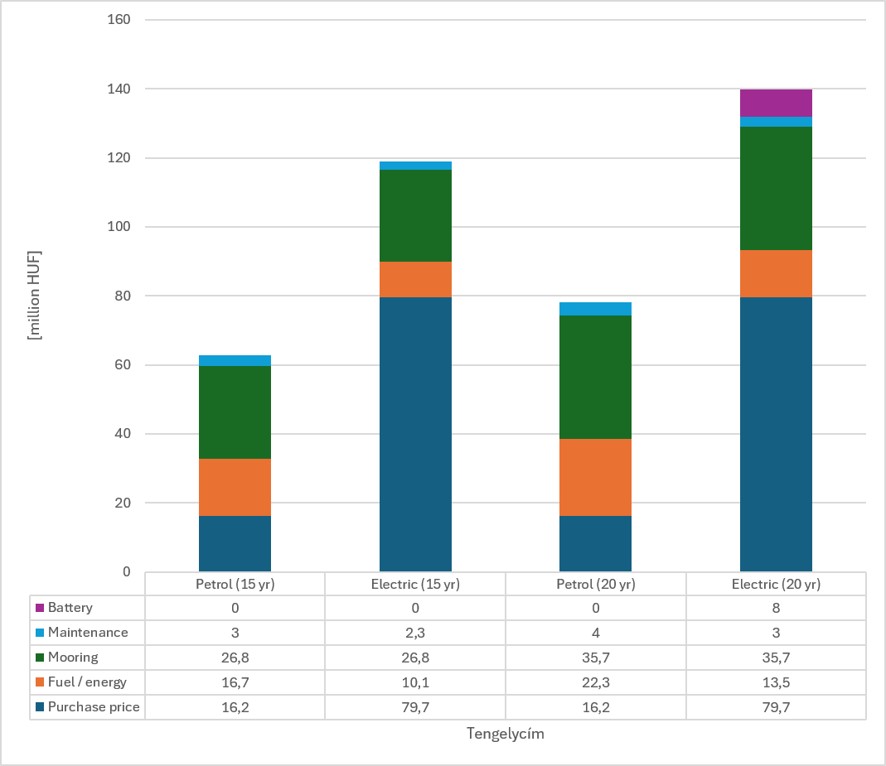
Because Lake Balaton is shallow and ecologically fragile, the regulation of small-boat traffic on the lake currently rests mainly on propulsion type: recreational use of internal-combustion-powered small boats is effectively prohibited. In contrast, purely electric-powered boats may operate freely. This study examines the environmental and economic differences between petrol and electric-powered small boats over their full life cycle, and considers what these differences imply for further developing the regulatory framework. The analysis draws on data from one specific petrol-powered and one electric small-boat model. The life cycle assessment (LCA) compares CO2 emissions across the manufacturing, operational, and end-of-life (EoL) phases over 15-year and 20-year horizons, while the total cost of ownership (TCO) analysis compares investment, operating, mooring, and maintenance costs over the same horizons. Results: manufacturing emissions for the electric boat are nearly five times those of the petrol boat, but this disadvantage is offset by lower operating emissions within roughly 5.7 years; over 15 years, the electric boat’s total emissions are about half those of the petrol boat. The economic picture runs in the opposite direction: owing to its higher purchase price and the cost of battery replacement, the electric boat’s total cost exceeds the petrol boat’s over both examined time horizons. Since environmental and economic considerations do not align, sustainable boating cannot be reduced to a single criterion and instead calls for deliberate, multi-criteria evaluation. Regulation would benefit from accounting not only for propulsion type but also for the actual environmental burden a boat generates (speed, power, intensity of use).
References
Law: 30/2003. (III. 18.) Government decree on limiting water transport on certain inland waterways for environmental reasons and on the operating permits that can be issued in the areas subject to restriction. [in Hungarian: Korm. rendelet a víziközlekedés egyes belvízi utakon környezetvédelmi okokból való korlátozásáról és a korlátozás alá eső területeken kiadható üzemeltetési engedélyről.] URL: https://net.jogtar.hu/jogszabaly?docid=a0300030.kor (Downloaded: 24 September 2026)
Law: 57/2011. (XI. 22.) Ministry of National Development decree on the rules of water transport. [in Hungarian: NFM rendelet a víziközlekedés rendjéről]. Magyar Közlöny. 2011/140. sz. URL: https://net.jogtar.hu/jogszabaly?docid=a1100057.nfm (Downloaded: 24 September 2026)
Boat Garda (n.d.). Navigation rules at Lake Garda. BOATGARDA. URL: https://www.boatgarda.com/en/boat-services-lake-garda-nautical-license/navigation-rules-lake-garda/ (Downloaded: 8 March 2026)
Boote-Magazin (2016). Bodensee – emission regulations: fewer exceptions. URL: https://www.boote-magazin.de/en/boat-knowledge/law/bodensee-emission-regulations-fewer-exceptions/ (Downloaded: 8 March 2026)
Bordbar, A., Moutik, B., Kyte, A., Ussher, S., Collins, K., Roszkowski, M., Wilson, T., Fear, S. (2025). Life cycle assessment comparing electric and petrol-powered rigid inflatable boats for recreational and harbour-master applications. Ocean Engineering. 341, 122664. DOI: https://doi.org/10.1016/j.oceaneng.2025.122664
Carreño, A., Lloret, J. (2021). Environmental impacts of increasing leisure boating activity in Mediterranean coastal waters. Ocean & Coastal Management. 209, 105693. DOI: https://doi.org/10.1016/j.ocecoaman.2021.105693
Csősz, L. (2021). A summary of the current state of Lake Balaton from a water management perspective. [in Hungarian: A Balaton jelenlegi állapotának vízügyi szempontú összefoglalása]. Military Engineer. [in Hungarian: Hadmérnök]. 16(2), 47–55. DOI: https://doi.org/10.32567/hm.2021.2.4
Depree, C. (2007). Potential impacts of emissions from outboard motors on the aquatic environment: A literature review (NIWA Client Report: HAM2007-026). National Institute of Water & Atmospheric Research. URL: https://www.envirolink.govt.nz/assets/Envirolink/232-WCRC26.pdf (Downloaded: 8 March 2026)
Ellingsen, L. A.-W., Majeau-Bettez, G., Singh, B., Srivastava, A. K., Valøen, L. O., Strømman, A. H. (2014). Life cycle assessment of a lithium-ion battery pack. Journal of Industrial Ecology. 18(1), 113–124. DOI: https://doi.org/10.1111/jiec.12072
Ember (2022). European Electricity Review 2022. Ember. URL: https://ember-energy.org/latest-insights/european-electricity-review-2022/ (Downloaded: 8 March 2026)
Gabel, F., Lorenz, S., Stoll, S. (2017). Effects of ship-induced waves on aquatic ecosystems. Science of the Total Environment. 601–602, 926–939. DOI: https://doi.org/10.1016/j.scitotenv.2017.05.206
Giardino, C., Brando, V. E., Dekker, A. G., Strömbeck, N., Candiani, G. (2007). Assessment of water quality in Lake Garda (Italy) using Hyperion. Remote Sensing of Environment. 109, 183–195. DOI: https://doi.org/10.1016/j.rse.2006.12.017
Istvánovics, V., Clement, A., Somlyódy, L., Specziár, A., G.-Tóth, L., Padisák, J. (2007). Updating water quality targets for shallow Lake Balaton (Hungary), recovering from eutrophication. Hydrobiologia. 581(1), 305–318. DOI: https://doi,org//10.1007/s10750-006-0509-1
Jeong, B., Wang, H., Oguz, E., Zhou, P. (2018). An effective framework for life cycle and cost assessment for marine vessels aiming to select optimal propulsion systems. Journal of Cleaner Production. 187, 111–130. DOI: https://doi.org/10.1016/j.jclepro.2018.03.184
Jüttner, F., Backhaus, D., Matthias, U., Essers, U., Greiner, R., Mahr, B. (1995). Emissions of two- and four-stroke outboard engines – II. Impact on water quality. Water Research. 29(8), 1983–1987. DOI: https://doi.org/10.1016/0043-1354(94)00331-Z
Kunc, H. P., McLaughlin, K. E., Schmidt, R. (2016). Aquatic noise pollution: Implications for individuals, populations, and ecosystems. Proceedings of the Royal Society B: Biological Sciences. 283(1836), 20160839. DOI: https://doi.org/10.1098/rspb.2016.0839
Mosisch, T. D., & Arthington, A. H. (2004). Impacts of recreational power-boating on freshwater ecosystems. In R. Buckley (Ed.), Environmental impacts of ecotourism. CABI Publishing. 125–154. DOI: 10.1079/9780851998107.0125
MVM Next (n.d.). A magyar villamosenergia-mix összetétele és fajlagos szén-dioxid kibocsátása. URL: https://www.mvmnext.hu/aram/pages/aloldal.jsp?id=10817872 (Downloaded: 8 March 2026)
OVF – Országos Vízügyi Főigazgatóság (n.d.). Balaton – vízügyi adatok és információk. https://www.vizugy.hu/index.php?module=content&programelemid=2 (Downloaded: 14 October 2026)
Takács, P., Turcsányi, B., Bíró, P. (2013). Társadalmi konfliktusokat generáló ökológiai történések a Balaton életében az utóbbi néhány évtizedben – Halpusztulások. Acta Scientiarum Socialium. 39, 51–56. URL: https://journal.uni-mate.hu/index.php/asc/hu/article/view/316 (Downloaded: 14 October 2026)
Viana, M., Hammingh, P., Colette, A., Querol, X., Degraeuwe, B., de Vlieger, I., & van Aardenne, J. (2014). Impact of maritime transport emissions on coastal air quality in Europe. Atmospheric Environment. 90, 96–105. DOI: https://doi.org/10.1016/j.atmosenv.2014.03.046
Zalacko, R., Zöldy, M., Simongáti, G. (2020). Comparative study of two simple marine engine BSFC estimation methods. Brodogradnja/Shipbuilding. 71(3), 13–25. DOI: https://doi.org/10.21278/brod71302
Zsoldos, B., Zöldy, M., Nagy, A. (2025). Waste-based fuels as part of sustainable mobility. Cognitive Sustainability, 4(4). DOI: https://doi.org/10.55343/CogSust.20524
Zöldy, M., Baranyi, P. (2023). The Cognitive Mobility Concept. Infocommunications Journal, Special Issue: Internet of Digital & Cognitive Realities, 35–40. DOI: https://doi.org/10.36244/ICJ.2023.SI-IODCR.6
Zöldy, M., Szalmáné Csete, M., Kolozsi, P. P., Bordás, P., Török, Á. (2022). Cognitive Sustainability. Cognitive Sustainability, 1(1). DOI: https://doi.org/10.55343/CogSust.7