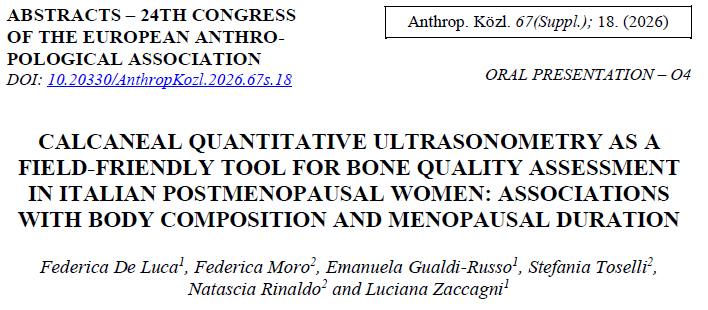
Calcaneal quantitative ultrasonometry as a field-friendly tool for bone quality assessment in Italian postmenopausal women: Associations with body composition and menopausal duration
Absztrakt
Background: In postmenopausal women, bone quality assessment is essential for identifying skeletal fragility risk. The calcaneal Bone Quality Index (BQI), assessed via quantitative ultrasound (QUS), represents a non-invasive, field-friendly alternative to dual-energy X-ray absorptiometry (DXA).
Objective: To investigate the associations between BQI, body composition, menopausal duration and functional variables in Italian postmenopausal women.
Subjects and methods: A cross-sectional study design – in which all measurements were taken at a single point in time – was conducted on 138 Italian postmenopausal women (mean age: 61.1±5.3 years; mean years since menopause (YSM): 10.5±6.1 years). BQI was assessed using calcaneal QUS (SONOST 3000). Body composition was assessed through bioelectrical impedance analysis (BIA 101, Akern), providing fat-free mass (FFM), fat mass (FM) and fat percentage (%F). Handgrip strength (HGS) was measured bilaterally using a dynamometer. Pearson correlations and two multiple linear regression models were performed using BQI as the dependent variable: a background model (age, YSM, BMI) and a body composition model (%F, FFM, HGS). A simple linear regression with YSM alone was also conducted.
Results: BQI showed significant negative correlations with age (r=−0.30, p=0.0003) and YSM (r=−0.34, p<0.0001), and positive correlations with BMI, FFM and FM (r=0.18 for all, p=0.033). No significant correlations emerged for %F and HGS. The body composition model was not statistically significant (F=1.864, R²=0.040, p=0.139), whereas the background model was statistically significant (F=7.133, R²=0.138, p=0.0002), with YSM as the strongest predictor (p<0.0001). In simple linear regression, YSM alone explained 12% of BQI variance (R²=0.120, p<0.0001).
Conclusions: Menopausal duration is the primary determinant of calcaneal bone quality in postmenopausal women, independent of body composition. These findings support the use of calcaneal QUS as a field-friendly pre-screening tool for bone quality monitoring in non-clinical and large-scale epidemiological settings.
Hivatkozások