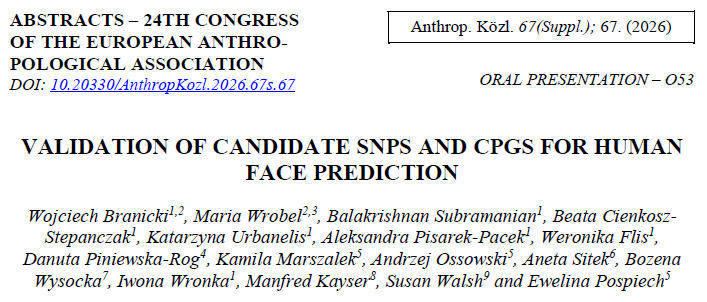
Validation of candidate SNPs and CpGs for human face prediction

  • Wojciech Branicki Jagiellonian University, Faculty of Biology, Institute of Zoology and Biomedical Sciences, Laboratory of Anthropology, Krakow, Poland; Institute of Forensic Research, Krakow, Poland
  • Maria Wrobel Institute of Forensic Research, Krakow, Poland; Jagiellonian University, Doctoral School of Exact and Natural Sciences, Krakow, Poland
  • Balakrishnan Subramanian Jagiellonian University, Faculty of Biology, Institute of Zoology and Biomedical Sciences, Laboratory of Anthropology, Krakow, Poland
  • Beata Cienkosz-Stepanczak Jagiellonian University, Faculty of Biology, Institute of Zoology and Biomedical Sciences, Laboratory of Anthropology, Krakow, Poland
  • Katarzyna Urbanelis Jagiellonian University, Faculty of Biology, Institute of Zoology and Biomedical Sciences, Laboratory of Anthropology, Krakow, Poland
  • Aleksandra Pisarek-Pacek Jagiellonian University, Faculty of Biology, Institute of Zoology and Biomedical Sciences, Laboratory of Anthropology, Krakow, Poland
  • Weronika Flis Jagiellonian University, Faculty of Biology, Institute of Zoology and Biomedical Sciences, Laboratory of Anthropology, Krakow, Poland
  • Danuta Piniewska-Rog Jagiellonian University Medical College, Faculty of Medicine, Department of Forensic Medicine, Krakow, Poland
  • Kamila Marszalek Pomeranian Medical University, Department of Forensic Genetics, Szczecin, Poland
  • Andrzej Ossowski Pomeranian Medical University, Department of Forensic Genetics, Szczecin, Poland
  • Aneta Sitek University of Lodz, Faculty of Biology and Environmental Protection, Institute of Ecology and Environmental Protection, Department of Anthropology, Lodz, Poland
  • Bozena Wysocka Central Forensic Laboratory of the Police, Warsaw, Poland
  • Iwona Wronka Jagiellonian University, Faculty of Biology, Institute of Zoology and Biomedical Sciences, Laboratory of Anthropology, Krakow, Poland
  • Manfred Kayser Erasmus MC University Medical Center, Department of Pathology and Clinical Bioinformatics, Rotterdam, The Netherlands
  • Susan Walsh Indiana University Indianapolis, Department of Biology, Indianapolis, USA
  • Ewelina Pospiech Pomeranian Medical University, Department of Forensic Genetics, Szczecin, Poland
Keywords: Human face morphology, BMI, Phenotyping, DNA-based prediction

Abstract

Background: Human facial genetics remains challenging due to the complexity of facial morphology, its highly polygenic basis, and the combined influence of genetics, environment, age, and lifestyle on facial appearance.

Objective: To develop predictors of human facial appearance that could aid facial reconstruction in forensic anthropology and predict facial appearance using DNA-based methods alone.

Subjects and methods: Data from ~800 individuals, including Illumina GSA genotypes, EPIC methylation profiles, metadata, and 3D facial scans, were analyzed. Candidate facial SNPs were evaluated using MeshMonk with facial segmentation and landmark-based phenotyping. Associations were tested between 747 DNA variants and facial traits in 658 individuals. In addition, BMI-predictive CpG sites were validated, and a compact BMI prediction model was developed using Elastic Net regression on methylation data from 624 individuals.

Results: Using global-to-local segmentation approach we found 29 SNPs to be significantly associated with 22 segments of the faces. The facial landmarking approach identified 27 candidate SNPs to be significantly associated with 60 facial distances. Elastic Net regression yielded 30 CpG BMI predictors. In the validation set, the model achieved a mean absolute error of 2.9 kg/m². The current results represent a step forward in our research on facial prediction.

References
References: None.
Published
2026-08-07
Section
Abstracts - Oral presentation