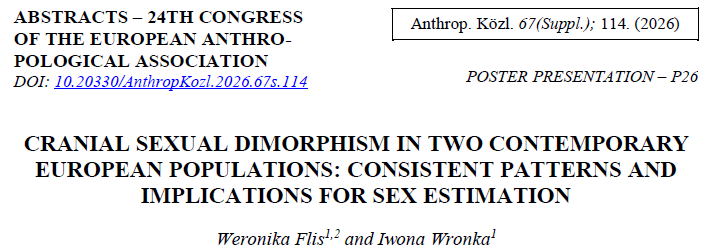
Cranial sexual dimorphism in two contemporary European populations: Consistent patterns and implications for sex estimation
Abstract
Background: Sex estimation is a fundamental task in forensic anthropology and bioarchaeology. However, the expression of sexual dimorphism varies according to population specificity, secular trends, and biological as well as environmental factors. For this reason, it is necessary to validate existing methods and to develop new ones.
Objective: To assess cranial sexual dimorphism in two European populations and compare patterns in cranial measurements, morphology, and indices between groups.
Materials and methods: The material consisted of two series of macerated adult skulls with documented sex and age at death: 68 from a modern Portuguese population (36 females, 32 males) and 84 from a twentieth-century Greek population (38 females, 46 males). For each skull, 27 standard cranial measurements were taken, cranial indices were calculated, and morphological traits known to exhibit sexual dimorphism were evaluated. Sex differences in nonmetric traits were assessed using logistic regression, whereas metric traits were evaluated by means of discriminant function analysis.
Results: No significant differences were found in the magnitude of sexual dimorphism between the two populations. In both groups, cranial dimensions showed greater sex differentiation than cranial indices, with the strongest dimorphism observed in the mid-craniofacial region. Among the descriptive traits, glabellar shape, zygomatic arch prominence, mandibular body height, and the size of the mandibular condylar process displayed the highest degree of sexual dimorphism. Significant correlations between metric and nonmetric traits were also observed. Regardless of biological sex, larger skulls tended to exhibit more pronounced masculinized features, whereas smaller skulls showed more feminized characteristics. Anthropological sex estimation methods demonstrated 100% agreement with documented sex in males, while 6 females (8.11%) were misclassified.
Conclusions: Cranial traits show consistent sexual dimorphism across populations. Combining metric and morphological data improves accuracy and reduces error, supporting improved sex estimation methods in forensic anthropology for modern European samples.
References