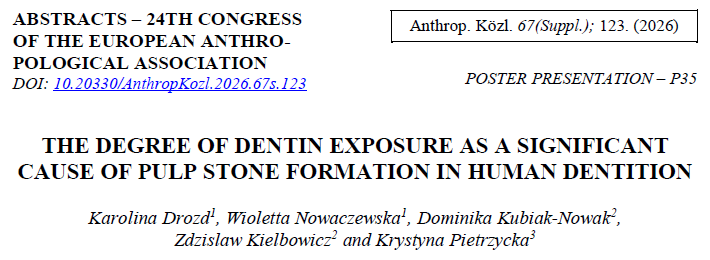
The degree of dentin exposure as a significant cause of pulp stone formation in human dentition
Abstract
pulp chamber of permanent molars. The causes of these structures have not yet been fully understood. Among the hypothetical factors influencing their occurrence is the importance of mechanical stimuli induced by the dental wear process.
Objective: The main aim of this study was to test the mechanical stimulation hypothesis mentioned above.
Materials and methods: The study material consisted of permanent lower molars belonging to representatives of two human populations dating from the Middle Ages and the turn of the 19th/20th century. The presence of PS was diagnosed based on CT images of the examined teeth using RadiAnt DICOM Viewer software, and the degree of dentin exposure was determined using a 40-point scale. Due to the relatively small number of adequately preserved molars (n=169, M1–M3), statistical analyses were performed for all molars combined (without considering the division into population types and separately for each of the populations), and for both populations combined separately for three molar types. The original tooth wear scale was converted to a three-level scale.
The relationship between the frequency of PS and the degree of tooth wear for each type of analysis was analysed using Pearson chi-square tests (p<0.05).
Results: The results indicated a statistically significant relationship between the occurrence of PS and the degree of dentin exposure in the case of the first two types of analyses (for all molars together: without division into populations (28.84; p<0.05), with division into two populations (26.38; p<0.05 and 10.17; p<0.05, respectively). The finding of a positive relationship between these features (positive value of Kendall’s tau-c) supports the hypothesis put forward. This relationship was not established for each of the molar types analysed separately (related to the small sample size of the subgroups).
References