Az ESTPHAD koncepció
II. rész: Ternér izomorf egyensúlyi fázisdiagram
Absztrakt
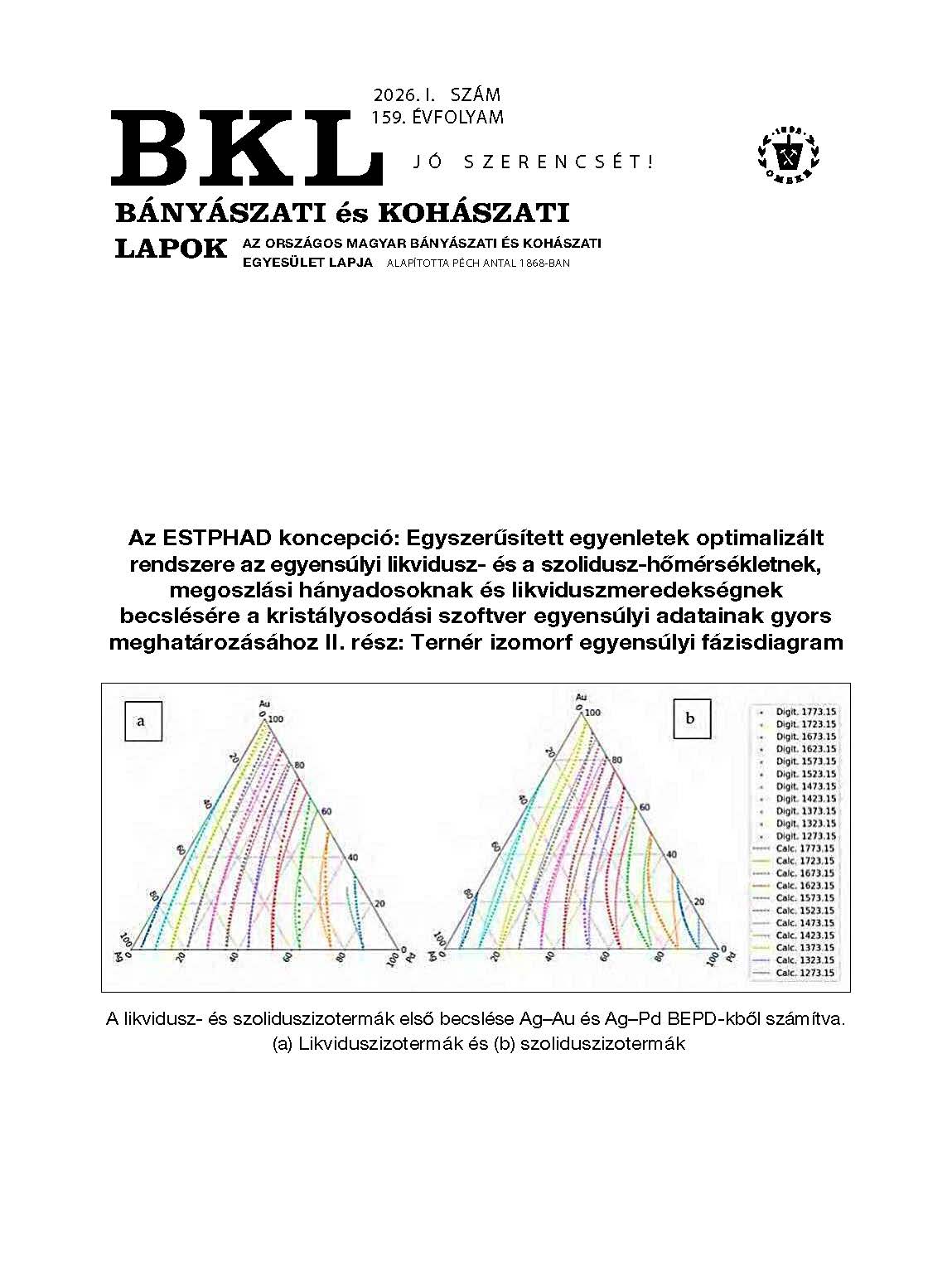
Egy korábbi cikkben bemutattunk egy eljárást a kétalkotós (binér) egyensúlyi fázisdiagramok likvidusz- és szoliduszvonalainak kiszámítására. Jelen cikkben a termodinamikai alapokat megtartva a módszert továbbfejlesztettük a háromalkotós (ternér) fázisdiagramok likvidusz és szolidus felületeinek közelítő számítására. Megmutatjuk, hogy az eljárás hierarchikus felépítésű, a felületek számítására használt függvények tartalmazzák a kétalkotós diagramoknál kapott függvényeket. A módszer alkalmazhatóságát az Ag–Au–Pd izomorf háromalkotós egyensúlyi fázisdiagram likvidusz- és szolidusfelületeinek kiszámításával ellenőrizzük. A kidolgozott négyszintű eljárás egyes szintjeinek alkalmazása a rendelkezésre álló adatoktól és a céltól függ. Kimutattuk, hogy az ötvözet tiszta alap eleméhez közeli koncentrációtartomány esetén a háromalkotós egyensúlyi fázisdiagram likvidusz- és szoliduszfelületei néhány K hibával kiszámíthatók a kétalkotós egyensúlyi fázisdiagramok likvidusz- és szoliduszfüggvényeiből. Az egyensúlyi fázisdiagramok grafikus formában voltak elérhetőek, így a diagramok digitalizálásával nyert adatokat használtuk fel a számításokhoz. A függvények deriválásával meghatározhatók a felületek meredekségéi, és bemutatjuk a megoszlási hányadosok kiszámítására kidolgozott becslő módszert is.
Másodközlés – Eredeti közlemény:
The ESTPHAD Concept: An Optimised Set of Simplified Equations to Estimate the Equilibrium Liquidus and Solidus Temperatures, Partition Ratios, and Liquidus Slopes for Quick Access to Equilibrium Data in Solidification Software Part II: Ternary Isomorphous Equilibrium Phase Diagram Phase Diagrams
https://doi.org/10.3390/met15070803
Hivatkozások
Kaufman, L.; Bernstein, H. Computer Calculation of Phase Diagrams; Academic Press: New York, NY, USA, 1970.
Yan, X.; Chen, S.; Xie, F.; Chang, Y.A. Computational and experimental investigation of microsegregation in an Al-rich Al-Cu-Mg-Si quaternary alloy. Acta. Mater. 2002, 50, 2199-2207. https://doi.org/10.1016/S1359-6454(01)00431-1
Ferreira, I.L.; Garcia, A.; Nestler, B. On macrosegregation in ternary Al-Cu-Si alloys: Numerical and experimental analysis. Scr. Mater. 2004, 50, 407-411. https://doi.org/10.1016/j.scriptamat.2003.11.012
Du, Q.; Eskin, D.G.; Katgerman, L. Modeling Macrosegregation during Direct-Chill Casting of Multicomponent Aluminium Alloys. Metall. Mater. Trans. A 2007, 38, 180-189. https://doi.org/10.1007/s11661-006-9042-0
Kattner, U. The Thermodynamic Modelling of Multicomponent Phase Equilibria. JOM 1997, 49, 14-19. https://doi.org/10.1007/s11837-997-0024-5
Greven, K.; Ludwig, A.; Hofmeister, T.; Sahm, R.R. Solidification of Metallic Melts in Research and Technology; Ludwig, A., Ed.; Wiley VCH: Weinheim, Germany, 1999; p.119.
Grafe, U.; Böttger, B.; Tiaden, J.; Fries, S.G. Coupling of Multicomponent Thermodynamic Databases to a Phase Field Model: Application to Solidification and Solid State Transformations of Superalloys. Scr. Mater. 2000, 42, 1179-1186. https://doi.org/10.1016/S1359-6462(00)00355-9
Boettinger, W.J.; Coriell, S.R.; Greer, A.L.; Karma, A.; Kurz, W.; Rappaz, M.; Trivedi, R. Solidification microstructures: Recent developments, future directions. Acta Mater. 2000, 48, 43-70. https://doi.org/10.1016/S1359-6454(99)00287-6
Zhang, C.; Miao, J.; Chen, S.; Zhang, F.; Luo, A.A. CALPHAD-Based Modelling and Experimental Validation of Microstructural Evaluation and Microsegregation in Magnesium Alloys During Solidification. J. Phase Equilib. Diffus. 2019, 40, 495-507. https://doi.org/10.1007/s11669-019-00732-0
Mikolajczak, P.; Geanau, A.; Ratke, L. Mushy Zone Calculation with Application of CALPHAD Technique. Metals 2017, 7, 363. https://doi.org/10.3390/met7090363
Dore, X.; Combeau, H.; Rappaz, M. Modelling of microsegregation in ternary alloys: Application to the solidification of Al-Mg-Si. Acta. Mater. 2000, 48, 3951-3962. https://doi.org/10.1016/S1359-6454(00)00177-4
Du, Q.; Eskin, D.G.; Katgerman, L. An efficient technique for describing a multi-component open system solidification path. Comput. Coupling Phase Diagr. Thermochem. 2008, 32, 478-484. https://doi.org/10.1016/j.calphad.2008.06.007
Zhao, G.; Xu, D.; Fu, H. ThermoCalc-based numerical computations for temperature, fraction of solid phase and composition couplings in alloy solidification, Int. Mat. Res. 2008, 99, 680-688. https://doi.org/10.3139/146.101675
Zhao, G.; Li, X.Z.; Xu, D.; Guo, J.; Fu, H.; Du, Y.; He, Y. Numerical Computations for Temperature, fraction of Solid Phase and Composition coupling in Ternary Alloy Solidification with Three Different Thermodynamic Data-acquisition Method. Calphad 2012, 36, 155-162. https://doi.org/10.1016/j.calphad.2011.07.002
Qiu, K.; Wang, R.C.; Peng, C.Q. Mathematical model of Likvidusz Temperature in Quaternary Aluminium Phase Diagram. Adv. Mater. Res. 2015, 1095, 545-548. https://doi.org/10.4028/www.scientific.net/AMR.1095.545
K. Qiu, R. Wang, Ch. Peng, X. lu, N. Wang, Polynomial regression and interpolation of thermodynamic data in Al-Si-Mg-Fe system. Comput. Coupling Phase Diagr. Thermochem. 2015, 48, 175-183. https://doi.org/10.1016/j.calphad.2015.01.005
Djurdjevic, M.B.; Manasijevic, A.; Odonovic, Z.; Dolic, N. Calculation of Likvidusz Temperature for Aluminium and Magnesium alloys Applying Method of Equivalency. Adv. Mater. Sci. Eng. 2013, 2013, 170527. https://doi.org/10.1155/2013/170527
Robles Hernandez, F.C.; Djurdjevic, M.B.; Kierkus, W.T.; Sokolowski, J.H. Calculation of the likvidusz temperature for hypo and hypereutectic aluminium silicon alloys. Mater. Sci. Eng. A 2005, 396, 271-276. https://doi.org/10.1016/j.msea.2005.01.024
Farahany, S.; Erfani, M.; Karamoozia, A.; Ourdjini, A.; Idris, M.H. Artificial Neural Networks to Predict of Likvidusz Temperature in Hypoeutectic Al-Si Cast Alloys. J. Appl. Sci. 2010, 10, 3243-3249. https://doi.org/10.3923/jas.2010.3243.3249
Wang, X.; Wang, X.; Wang, B.; Wang, B.; Liu, Q. Differential Calculation Model for Likvidusz Temperature of Steel. Steel Res. Int. 2011, 82, 164-168. https://doi.org/10.1002/srin.201000080
Min, L.; Hongbo, L.; Rongyuan, X.; Xiaorui, C.; Ying, L.; Hao, X.; Caidong, Z.; Zhiqiang, T. Investigation of the likvidusz temperature calculation method for medium manganese steel. High Temp. Mater. Process. 2023, 42, 20220285. https://doi.org/10.1515/htmp-2022-0285.
Sertucha, J.; Lacaze, J.; Regordosa, A.; Suarez, R. Polynomial Description of the Fe-C-Si Stable Phase Diagram for up to 4.5 Wt% Si, Including the Effect of Cr, Cu, Mn and P. Int. J. Met. 2025, 19, 1847-1856. https://doi.org/10.1007/s40962-024-01428-z.
Vorozhtcov, V.A.; Pavelina, M.E.; Stolyarova, V.L.; Fedorova, A.V.; Sinelshchikova, O.Y.; Almjashev, V.I. Likvidusz temperatures in the La2O3-SrO-TiO2-ZrO2-Fe2O3 system: Calculation and experiment. Ceram. Int. 2025, 51, 320-330. https://doi.org/10.1016/j.ceramint.2024.10.463.
Afanasyev, O.S.; Afanasyeva, E.A.; Egorov, G.F. Analytical Approximation and Numerical Simulation of Liquid for Nonequilibrium Multicomponent Eutectic Systems. Vestn. Samara State Tech. University. Tech. Sci. Ser. 2022, 30, 6-19. https://doi.org/10.14498/tech.2022.1.1.
Kőrösy, G.; Roósz, A.; Mende, T. The ESTPHAD Concept: An Optimised Set of Simplified equations to Estimate the Equilibrium Likvidusz and Szolidusz Temperatures, Partition Ratio and Likvidusz Slope for Quick Access to Equilibrium Data in Solidification Software, Part I: Binary equilibrium phase diagram. Metals 2024, 14, 1266. https://doi.org/10.3390/met14111266
Drost, E.; Hausselt, J. Uses of gold in jewellery. Interdiscip. Sci. Rev. 1992, 17, 271-280. https://doi.org/10.1179/030801892791925448
Kempf, B.; Hausselt, J. Gold, its alloys and their uses in dentistry. Interdiscip. Sci. Rev. 1992, 17, 251-260. https://doi.org/10.1179/isr.1992.17.3.251
Kempf, B.; Schmauder, S. Thermodynamic modelling of precious metals alloys. Gold Bull. 998, 31, 51-57. https://doi.org/10.1007/BF03214761
Bale, C.W.; Bélisle, E.; Chartrand, P.; Decterov, S.A.; Eriksson, G.; Gheribi, A.E.; Hack, K.; Jung, I.H.; Kang, Y.B.; Melançon, J.; et al. FactSage thermochemical software and databases, 2010-2016. Calphad 2016, 54, 35. https://doi.org/10.1016/j.calphad.2016.05.002
Alan Prince†, updated by Joachim Gröbner, Manga V. Rao, Viktor Kuznetsov, Landolt-Börnstein Book Series, Numerical Data and Functional Relationships in Science and Technology - New Series IV/11B, Ternary Alloy Systems -Silver-Gold-Palladium Phase Diagrams, Crystallographic and Thermodynamic Data, Vol. IV/11B: Noble Metal Systems, p.50-54, Silver-Gold-Palladium. Springer Nature BV
Venudhar, Y.C.; Iyengar, L.; Leela, R.; Krishna, K.V. Isoparametric Curves and Vegard's Law Plots for the Ternary System Palladium-Silver-Gold. Current Sci. 1978, 47, 717-719.
Nemilov, V.A.; Rudnitsky, A.A.; Vidusova, T.A. Investigation of the Au-Pd-Ag System. Izvest. Sekt. Platiny 1946, 20, 225-239.
Pauley, C.L. X-ray Study of the Stacking Fault Density near the Hardness Maximum of the Au-Ag-Pd System. Master's Thesis, Virginia Polytechnic Institute, Blacksburg, VA, USA, 1967.
Miane, J.M.; Gaune-Escard, M.; Bros, J.P. Likvidusz and Szolidusz Surface of the Ag-Au-Pd Equilibrium Phase Diagram. High Temp. High Press. 1977, 9, 465-469.