The ESTPHAD Concept
An Optimised Set of Simplified Equations to Estimate the Equilibrium Liquidus and Solidus Temperatures, Partition Ratios, and Liquidus Slopes for Quick Access to Equilibrium Data in Solidification Software Part II: Ternary Isomorphous Equilibrium Phase Diagram Phase Diagrams
Abstract
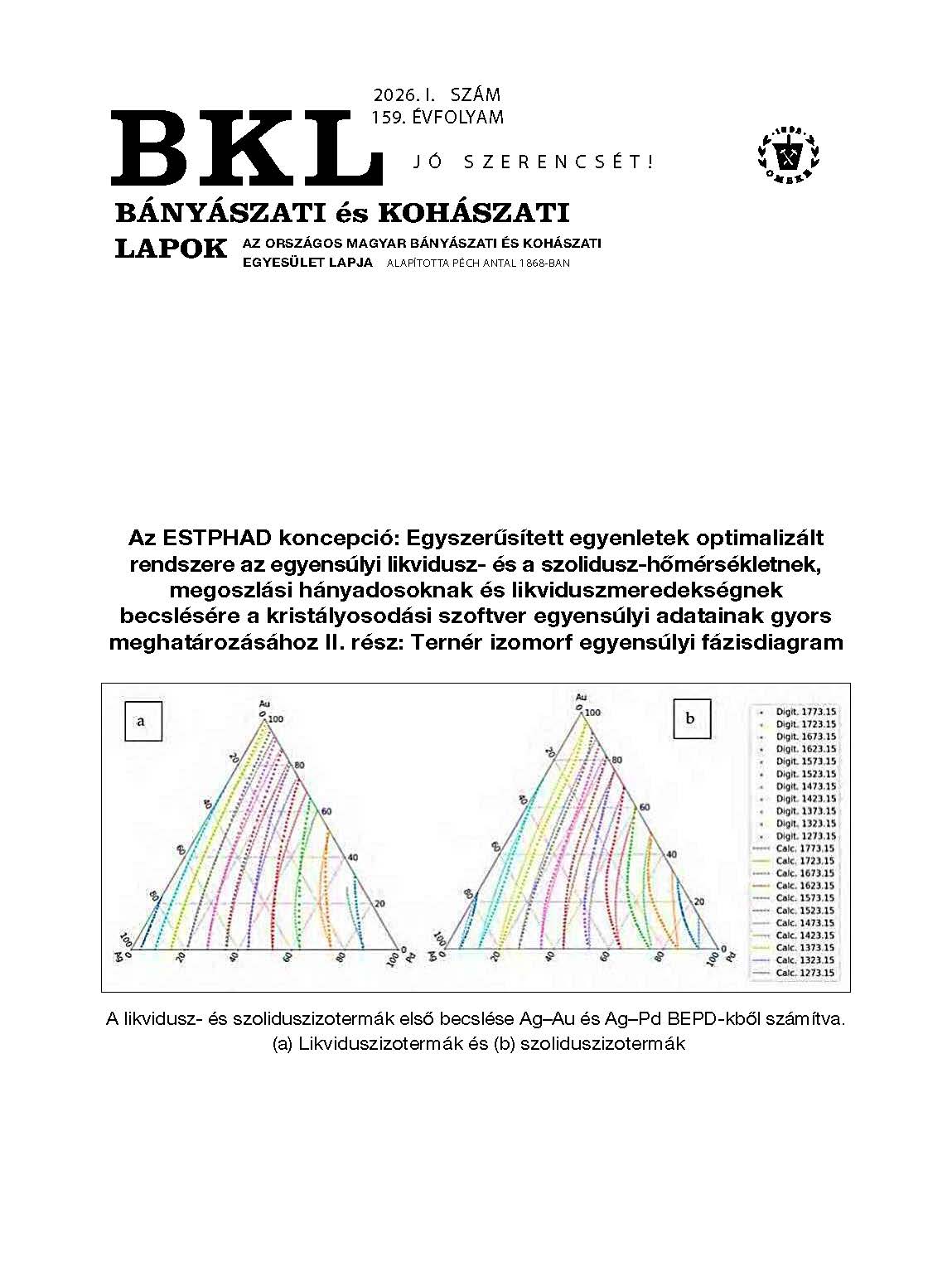
Egy korábbi cikkben bemutattunk egy eljárást a kétalkotós (binér) egyensúlyi fázisdiagramok likvidusz- és szoliduszvonalainak kiszámítására. Jelen cikkben a termodinamikai alapokat megtartva a módszert továbbfejlesztettük a háromalkotós (ternér) fázisdiagramok likvidusz és szolidus felületeinek közelítő számítására. Megmutatjuk, hogy az eljárás hierarchikus felépítésű, a felületek számítására használt függvények tartalmazzák a kétalkotós diagramoknál kapott függvényeket. A módszer alkalmazhatóságát az Ag–Au–Pd izomorf háromalkotós egyensúlyi fázisdiagram likvidusz- és szolidusfelületeinek kiszámításával ellenőrizzük. A kidolgozott négyszintű eljárás egyes szintjeinek alkalmazása a rendelkezésre álló adatoktól és a céltól függ. Kimutattuk, hogy az ötvözet tiszta alap eleméhez közeli koncentrációtartomány esetén a háromalkotós egyensúlyi fázisdiagram likvidusz- és szoliduszfelületei néhány K hibával kiszámíthatók a kétalkotós egyensúlyi fázisdiagramok likvidusz- és szoliduszfüggvényeiből. Az egyensúlyi fázisdiagramok grafikus formában voltak elérhetőek, így a diagramok digitalizálásával nyert adatokat használtuk fel a számításokhoz. A függvények deriválásával meghatározhatók a felületek meredekségéi, és bemutatjuk a megoszlási hányadosok kiszámítására kidolgozott becslő módszert is.
Másodközlés – Eredeti közlemény:
The ESTPHAD Concept: An Optimised Set of Simplified Equations to Estimate the Equilibrium Liquidus and Solidus Temperatures, Partition Ratios, and Liquidus Slopes for Quick Access to Equilibrium Data in Solidification Software Part II: Ternary Isomorphous Equilibrium Phase Diagram Phase Diagrams
https://doi.org/10.3390/met15070803
References
Kaufman, L.; Bernstein, H. Computer Calculation of Phase Diagrams; Academic Press: New York, NY, USA, 1970.
Yan, X.; Chen, S.; Xie, F.; Chang, Y.A. Computational and experimental investigation of microsegregation in an Al-rich Al-Cu-Mg-Si quaternary alloy. Acta. Mater. 2002, 50, 2199-2207. https://doi.org/10.1016/S1359-6454(01)00431-1
Ferreira, I.L.; Garcia, A.; Nestler, B. On macrosegregation in ternary Al-Cu-Si alloys: Numerical and experimental analysis. Scr. Mater. 2004, 50, 407-411. https://doi.org/10.1016/j.scriptamat.2003.11.012
Du, Q.; Eskin, D.G.; Katgerman, L. Modeling Macrosegregation during Direct-Chill Casting of Multicomponent Aluminium Alloys. Metall. Mater. Trans. A 2007, 38, 180-189. https://doi.org/10.1007/s11661-006-9042-0
Kattner, U. The Thermodynamic Modelling of Multicomponent Phase Equilibria. JOM 1997, 49, 14-19. https://doi.org/10.1007/s11837-997-0024-5
Greven, K.; Ludwig, A.; Hofmeister, T.; Sahm, R.R. Solidification of Metallic Melts in Research and Technology; Ludwig, A., Ed.; Wiley VCH: Weinheim, Germany, 1999; p.119.
Grafe, U.; Böttger, B.; Tiaden, J.; Fries, S.G. Coupling of Multicomponent Thermodynamic Databases to a Phase Field Model: Application to Solidification and Solid State Transformations of Superalloys. Scr. Mater. 2000, 42, 1179-1186. https://doi.org/10.1016/S1359-6462(00)00355-9
Boettinger, W.J.; Coriell, S.R.; Greer, A.L.; Karma, A.; Kurz, W.; Rappaz, M.; Trivedi, R. Solidification microstructures: Recent developments, future directions. Acta Mater. 2000, 48, 43-70. https://doi.org/10.1016/S1359-6454(99)00287-6
Zhang, C.; Miao, J.; Chen, S.; Zhang, F.; Luo, A.A. CALPHAD-Based Modelling and Experimental Validation of Microstructural Evaluation and Microsegregation in Magnesium Alloys During Solidification. J. Phase Equilib. Diffus. 2019, 40, 495-507. https://doi.org/10.1007/s11669-019-00732-0
Mikolajczak, P.; Geanau, A.; Ratke, L. Mushy Zone Calculation with Application of CALPHAD Technique. Metals 2017, 7, 363. https://doi.org/10.3390/met7090363
Dore, X.; Combeau, H.; Rappaz, M. Modelling of microsegregation in ternary alloys: Application to the solidification of Al-Mg-Si. Acta. Mater. 2000, 48, 3951-3962. https://doi.org/10.1016/S1359-6454(00)00177-4
Du, Q.; Eskin, D.G.; Katgerman, L. An efficient technique for describing a multi-component open system solidification path. Comput. Coupling Phase Diagr. Thermochem. 2008, 32, 478-484. https://doi.org/10.1016/j.calphad.2008.06.007
Zhao, G.; Xu, D.; Fu, H. ThermoCalc-based numerical computations for temperature, fraction of solid phase and composition couplings in alloy solidification, Int. Mat. Res. 2008, 99, 680-688. https://doi.org/10.3139/146.101675
Zhao, G.; Li, X.Z.; Xu, D.; Guo, J.; Fu, H.; Du, Y.; He, Y. Numerical Computations for Temperature, fraction of Solid Phase and Composition coupling in Ternary Alloy Solidification with Three Different Thermodynamic Data-acquisition Method. Calphad 2012, 36, 155-162. https://doi.org/10.1016/j.calphad.2011.07.002
Qiu, K.; Wang, R.C.; Peng, C.Q. Mathematical model of Likvidusz Temperature in Quaternary Aluminium Phase Diagram. Adv. Mater. Res. 2015, 1095, 545-548. https://doi.org/10.4028/www.scientific.net/AMR.1095.545
K. Qiu, R. Wang, Ch. Peng, X. lu, N. Wang, Polynomial regression and interpolation of thermodynamic data in Al-Si-Mg-Fe system. Comput. Coupling Phase Diagr. Thermochem. 2015, 48, 175-183. https://doi.org/10.1016/j.calphad.2015.01.005
Djurdjevic, M.B.; Manasijevic, A.; Odonovic, Z.; Dolic, N. Calculation of Likvidusz Temperature for Aluminium and Magnesium alloys Applying Method of Equivalency. Adv. Mater. Sci. Eng. 2013, 2013, 170527. https://doi.org/10.1155/2013/170527
Robles Hernandez, F.C.; Djurdjevic, M.B.; Kierkus, W.T.; Sokolowski, J.H. Calculation of the likvidusz temperature for hypo and hypereutectic aluminium silicon alloys. Mater. Sci. Eng. A 2005, 396, 271-276. https://doi.org/10.1016/j.msea.2005.01.024
Farahany, S.; Erfani, M.; Karamoozia, A.; Ourdjini, A.; Idris, M.H. Artificial Neural Networks to Predict of Likvidusz Temperature in Hypoeutectic Al-Si Cast Alloys. J. Appl. Sci. 2010, 10, 3243-3249. https://doi.org/10.3923/jas.2010.3243.3249
Wang, X.; Wang, X.; Wang, B.; Wang, B.; Liu, Q. Differential Calculation Model for Likvidusz Temperature of Steel. Steel Res. Int. 2011, 82, 164-168. https://doi.org/10.1002/srin.201000080
Min, L.; Hongbo, L.; Rongyuan, X.; Xiaorui, C.; Ying, L.; Hao, X.; Caidong, Z.; Zhiqiang, T. Investigation of the likvidusz temperature calculation method for medium manganese steel. High Temp. Mater. Process. 2023, 42, 20220285. https://doi.org/10.1515/htmp-2022-0285.
Sertucha, J.; Lacaze, J.; Regordosa, A.; Suarez, R. Polynomial Description of the Fe-C-Si Stable Phase Diagram for up to 4.5 Wt% Si, Including the Effect of Cr, Cu, Mn and P. Int. J. Met. 2025, 19, 1847-1856. https://doi.org/10.1007/s40962-024-01428-z.
Vorozhtcov, V.A.; Pavelina, M.E.; Stolyarova, V.L.; Fedorova, A.V.; Sinelshchikova, O.Y.; Almjashev, V.I. Likvidusz temperatures in the La2O3-SrO-TiO2-ZrO2-Fe2O3 system: Calculation and experiment. Ceram. Int. 2025, 51, 320-330. https://doi.org/10.1016/j.ceramint.2024.10.463.
Afanasyev, O.S.; Afanasyeva, E.A.; Egorov, G.F. Analytical Approximation and Numerical Simulation of Liquid for Nonequilibrium Multicomponent Eutectic Systems. Vestn. Samara State Tech. University. Tech. Sci. Ser. 2022, 30, 6-19. https://doi.org/10.14498/tech.2022.1.1.
Kőrösy, G.; Roósz, A.; Mende, T. The ESTPHAD Concept: An Optimised Set of Simplified equations to Estimate the Equilibrium Likvidusz and Szolidusz Temperatures, Partition Ratio and Likvidusz Slope for Quick Access to Equilibrium Data in Solidification Software, Part I: Binary equilibrium phase diagram. Metals 2024, 14, 1266. https://doi.org/10.3390/met14111266
Drost, E.; Hausselt, J. Uses of gold in jewellery. Interdiscip. Sci. Rev. 1992, 17, 271-280. https://doi.org/10.1179/030801892791925448
Kempf, B.; Hausselt, J. Gold, its alloys and their uses in dentistry. Interdiscip. Sci. Rev. 1992, 17, 251-260. https://doi.org/10.1179/isr.1992.17.3.251
Kempf, B.; Schmauder, S. Thermodynamic modelling of precious metals alloys. Gold Bull. 998, 31, 51-57. https://doi.org/10.1007/BF03214761
Bale, C.W.; Bélisle, E.; Chartrand, P.; Decterov, S.A.; Eriksson, G.; Gheribi, A.E.; Hack, K.; Jung, I.H.; Kang, Y.B.; Melançon, J.; et al. FactSage thermochemical software and databases, 2010-2016. Calphad 2016, 54, 35. https://doi.org/10.1016/j.calphad.2016.05.002
Alan Prince†, updated by Joachim Gröbner, Manga V. Rao, Viktor Kuznetsov, Landolt-Börnstein Book Series, Numerical Data and Functional Relationships in Science and Technology - New Series IV/11B, Ternary Alloy Systems -Silver-Gold-Palladium Phase Diagrams, Crystallographic and Thermodynamic Data, Vol. IV/11B: Noble Metal Systems, p.50-54, Silver-Gold-Palladium. Springer Nature BV
Venudhar, Y.C.; Iyengar, L.; Leela, R.; Krishna, K.V. Isoparametric Curves and Vegard's Law Plots for the Ternary System Palladium-Silver-Gold. Current Sci. 1978, 47, 717-719.
Nemilov, V.A.; Rudnitsky, A.A.; Vidusova, T.A. Investigation of the Au-Pd-Ag System. Izvest. Sekt. Platiny 1946, 20, 225-239.
Pauley, C.L. X-ray Study of the Stacking Fault Density near the Hardness Maximum of the Au-Ag-Pd System. Master's Thesis, Virginia Polytechnic Institute, Blacksburg, VA, USA, 1967.
Miane, J.M.; Gaune-Escard, M.; Bros, J.P. Likvidusz and Szolidusz Surface of the Ag-Au-Pd Equilibrium Phase Diagram. High Temp. High Press. 1977, 9, 465-469.