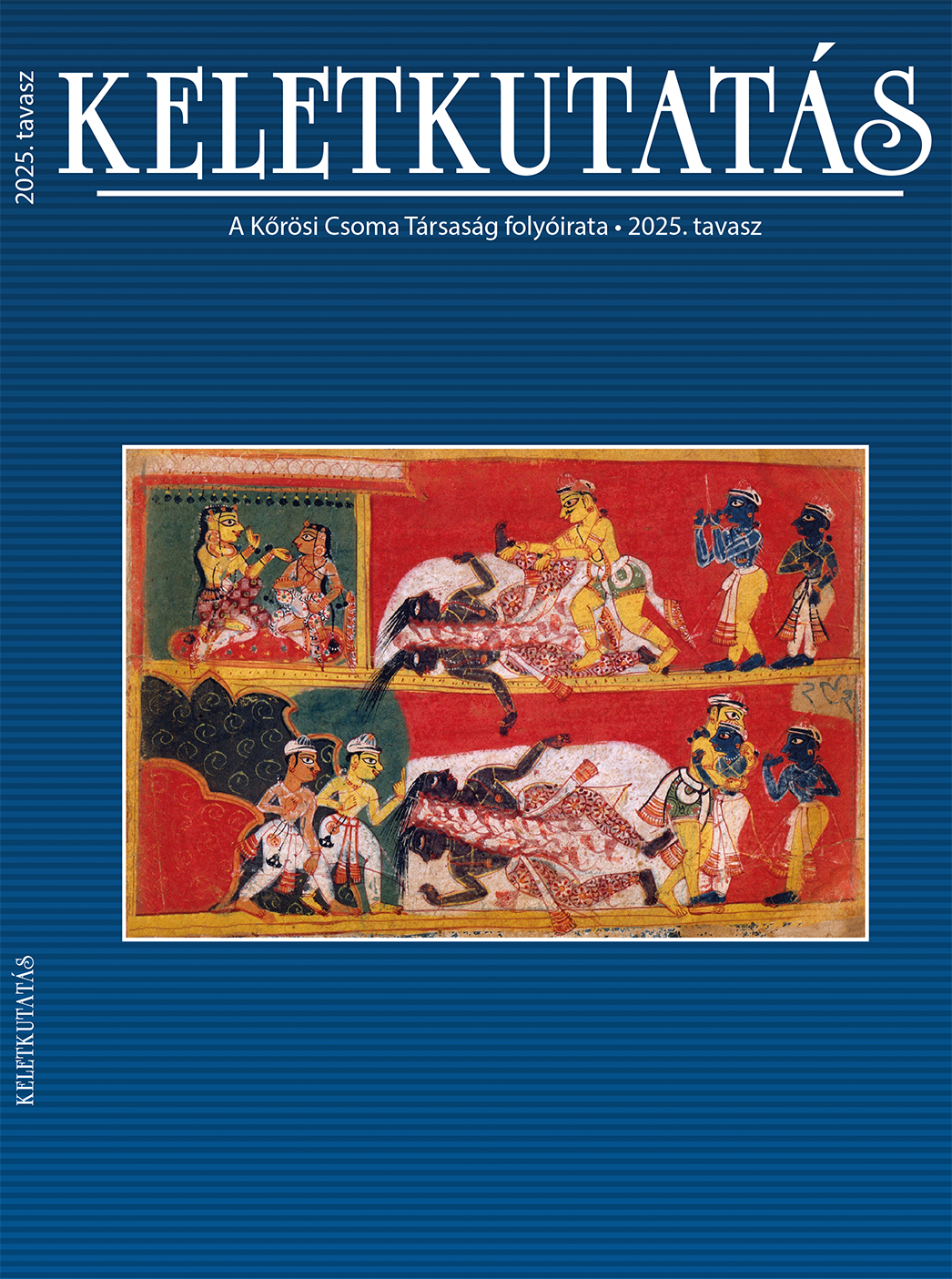
Merénylőből hős: Vezérmotívum a Kṛṣṇa-életrajzokban
Absztrakt
A merénylet visszatérő elem Kṛṣṇa életrajzaiban. Kaṃsát, Jarāsaṃdhát és Śiśupālát nem csupán Kṛṣṇa iránt tanúsított gyűlöletük kötötte össze, hanem az is, hogy kivétel nélkül merénylet áldozatai lettek. Írásomban a róluk szóló három merénylettörténetet vizsgálom meg, és a köztük felfedezhető párhuzamok alapján lehetséges magyarázatot próbálok adni a ma ismert Kṛṣṇa-mondakör formálódására.
Hivatkozások
Amarakoṣa. https://gretil.sub.uni-goettingen.de/gretil/corpustei/transformations-/html/sa_amarasiMha-nAmaliGgAnuzAsana.htm (2025. február 12.).
Bhagavadgītā with the commentaries of Śrīdhara, Madhusūdana, Viśvanātha and Baladeva. https://gretil.sub.uni-goettingen.de/gretil/corpustei/transformations/html/sa_bhagavadgItA-4comm.htm (2025. február 10.).
Brahmapurāṇa. https://gretil.sub.uni-goettingen.de/gretil/corpustei/¬transformations/-html/sa_brahmapurANa-1-246.htm (2025. február 17.).
Brockington, John L., Jarāsaṃdha of Magadha (MBh 2,15–22). In: Stages and Transitions. Temporal and Historical Frameworks in Epic and Purāṇic Literature. Ed. by Brockington, Mary. Zagreb, 2002.
Brockington, John L., The Sanskrit Epics. Boston–Leiden–Köln, 1998. https://doi.org/10.1163/9789004492677
Brockington, John L., The Spitzer Manuscript and the Mahābhārata. In: From Turfan to Ajanta. Festschrift for Dieter Schlingloff on the Occasion of his Eightieth Birthday. Ed. by Franco, Eli–Zin, Monika. Rupandehi, 2010, 75–87. https://doi.org/10.1553/3-7001-3301-4
Brodbeck, Simon, Divine Descent and the Four World-Ages in the Mahābhārata – or, Why Does the Kṛṣṇa Avatāra Inaugurate the Worst Yuga? Cardiff, 2022. https://doi.org/10.18573/book9
Cort, John E., An Overview of the Jaina Puranas. In: Purāṇa Perennis. Reciprocity and Transformation in Hindu and Jaina Texts. Ed. by Doniger, Wendy. Albany (NY), 1993, 185–206.
De Clercq, Eva, The Jaina Harivaṃśa and Mahābhārata Tradition: A Preliminary Study. In: Parallels and Comparisons. Proceedings of the Fourth Dubrovnik International Conference on the Sanskrit Epics and Purāṇas. Ed. by Ježić, Mislav–Koskikallio, Petteri. Zagreb, 2009, 399–421.
Feller, Danielle, The Sanskrit Epics’ Representations of Vedic Myths. Delhi, 2004.
Geen, Jonathan, Fair Trade and Reversal of Fortune: Kṛṣṇa and Mahāvīra in the Hindu and Jaina Traditions. Journal of the American Academy of Religion. 79/1 (2011) 58–89. https://doi.org/10.1093/jaarel/lfq059
Goldman, Robert P., A City of the Heart: Epic Mathurā and the Indian Imagination. Journal of the American Oriental Society 106 (1986) 471–483. https://doi.org/10.2307/602106
Granoff, Phyllis, Śiva and His Gaṇas: Techniques of Narrative Distancing in Purāṇic Stories. In: Voice of the Orient. (A Tribute to Prof. Upendranath Dhal). Ed. by Panda, Raghunath–Mishra, Madhusudan. Delhi, 2006, 77–103.
Hardy, Friedhelm, Viraha-Bhakti. The Early History of Kṛṣṇa Devotion in South India. Oxford–New York, 1983.
Hiltebeitel, Alf, Kṛṣṇa and the Mahābhārata (A Bibliographical Essay). Annals of the Bhandarkar Oriental Research Institute 60/1 (1979) 65–107. https://doi.org 10.2307/604651
Hiltebeitel, Alf, The Ritual of Battle. Krishna in the Mahābhārata. Ithaca–London, 1976.
Hiltebeitel, Alf, Rethinking the Mahābhārata. A Reader’s Guide to the Education of the Dharma King. Chicago–London, 2001.
Mani, Vettam, Purāṇic Encyclopaedia. A Comprehensive Dictionary with Special Reference to the Epic and Purāṇic Literature. Delhi–Patna–Varanasi, 1975.
Matsya-purāṇa. ld. https://gretil.sub.uni-goettingen.de/gretil/corpustei/¬transformations-/html/sa_matsyapurANa1-176.htm (2025. február 12.).
Pollock, Sheldon, The Rāmāyaṇa of Vālmīki. An Epic of Ancient India. II. Ayodhyākāṇḍa. Princeton, 1986. https://doi.org/10.2307/j.ctv1n1bs4v
Preciado-Solis, Benjamin, The Kṛṣṇa Cycle in the Purāṇas. Themes and Motifs in a Heroic Saga. New Delhi, 1984. https://doi.org/10.25911/5d70eeeb88a5d
Ruben, Walter, Krishna. Konkordanz und Kommentar der Motive seines Heldenlebens. Istanbul, 1944.
Schlingloff, Dieter, The Oldest Extant Parvan-List of the Mahābhārata. Journal of the American Oriental Society 89 (1969) 334–338. https://doi.org/10.2307/596517
Sircar, Dineshchandra, Studies in the Religious Life of Ancient and Medieval India. Delhi–Patna–Varanasi, 1971.
Sullivan, Bruce M., An Overview of Mahābhārata Scholarship: A Perspective on the State of the Field. Religion Compass 10/7 (2016) 165–175. https://doi.org/10.1111/rec3.12200
Száler Péter, Ghata-dzsátaka, avagy hogyan térítette meg a Buddha Krisnát? Keletkutatás 2023. tavasz, 135–151. https://doi.org/10.24391/KELETKUT.2023.1.135
Száler Péter, Menny és Pokol közt. Kansza megölése a Krisna-történetekben. Ókor 19 (2020) 42–49.
Tadapatrikar, S. N., The Kṛṣṇa Problem. Annals of the Bhandarkar Oriental Research Institute 10 (1929) 269–344.
Taylor, McComas, The Viṣṇu Purāṇa. Ancient Annals of the God with Lotus Eyes. Canberrra, 2021. https://doi.org/10.22459/VP.2021
The Bhāgavatapurāṇam. Ed. by Singh, Nag Sharan. Delhi, 1987.
The Critical Edition of the Viṣṇupurāṇam. Ed. by Pathak, M. M. Vadodara, 1997–1999.
The Harivaṃśa. Being the Khila or Supplement to the Mahābhārata. I–II. Ed. by Vaidya, Parashuram Lakshman. Poona, 1969–1971.
The Jātaka, Together with Its Commentary. Being Tales of the Anterior Births of Gotama Buddha. IV. Ed. by Fausbøll, Viggo. Kopenhagen–London–Strassburg, 1887.
The Kalpasūtra of Bhadrabāhu. Ed. by Jacobi, Hermann. Leipzig, 1879.
The Mahābhārata. I–XIX. Ed. by Sukthankar, Vishnu S. et al. Poona, 1927–1966.
The Śiśupālavadha by Mahākavi Māgha. Ed. by Antarāma Śāstrī Vetāl, Benares, 1929.
The Vālmīki-Rāmāyaṇa. Ed. by G. H. Bhatt et al. Baroda, 1960–1975.
Trynkowska, Anna, The Making of a Hero: Kṛṣṇa in Mahābhārata 2.30–42 and in Māgha’s Śiśupālavadha. Indologica Taurinensia 40 (2014) 357–369.
van Buitenen, Johannes A. B., The Mahābhārata. Book 1. The Book of the Beginning. Chicago–London, 1973. https://doi.org/10.7208/chicago/9780226217543.001.0001