Aeschynite, euxenite and samarskite group minerals from the vicinity of Lillafüred, Bükk Mts., Hungary
Abstract
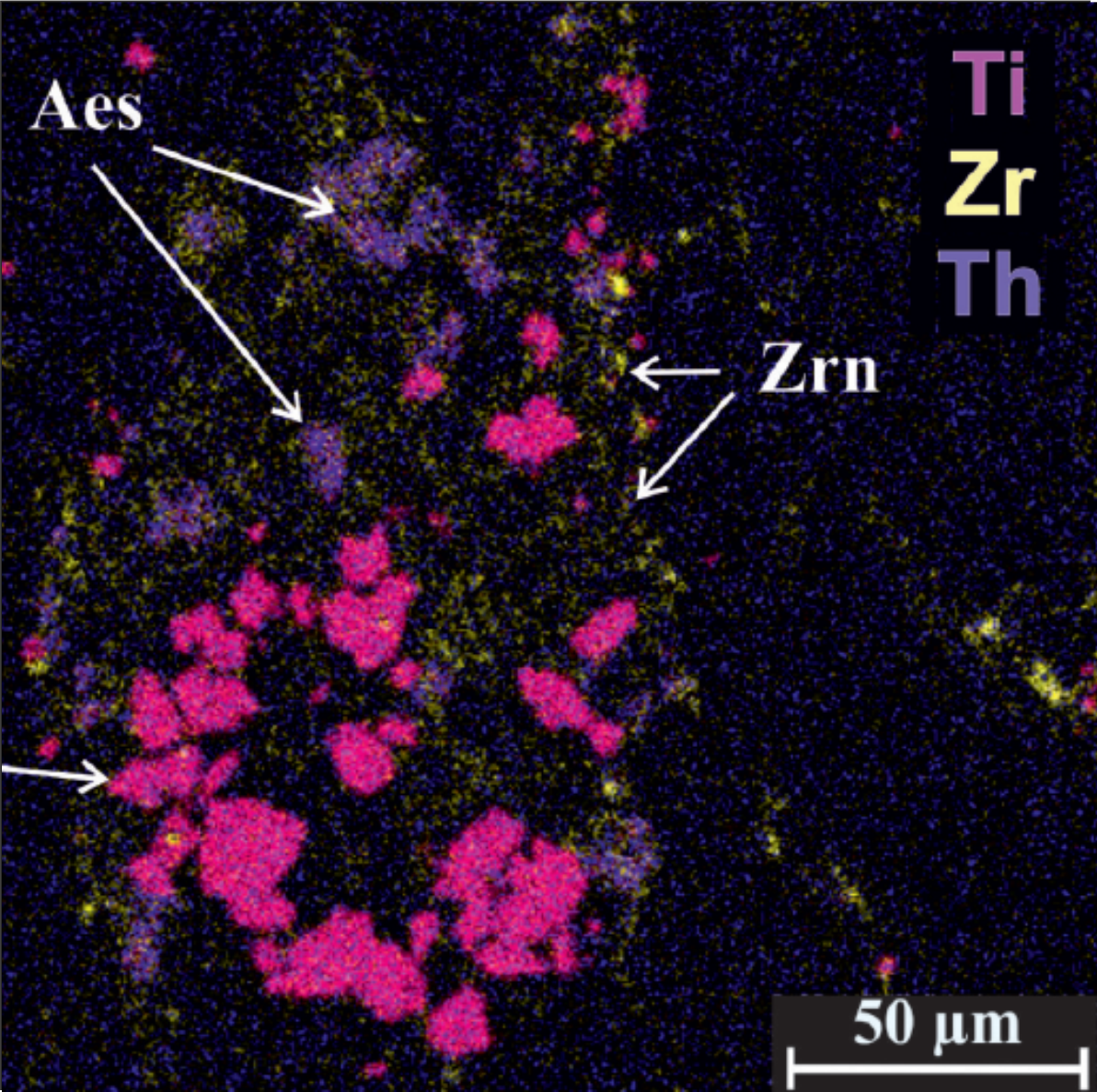
The occurrence of aeschynite-(Nd) and a mixture of euxenite-(Y) and samarskite-(Y) were verified in two rare element enriched siliciclastic beds at Lillafüred, Vesszős Valley, Bükk Mts., with WDX analyses and Raman spectroscopy. In the studied samples the composition is characteristic: either light or heavy rare earth elements + Y (LREE, HREE+Y) dominate in the minerals, and the two compositional types never occur together in the same bed. The calculated average chemical formula of the LREE-dominant variety (aeschynite-(Nd)) is the following: (Ca 0.2 Th 0.18 LREE 0.32 HREE 0.1 Y 0.14 K 0.01 Mg 0.04) (Ti 1.09 Nb 0.67 Ta 0.04 Fe 0.08 Si 0.07 Al 0.04) (O 5.77 OH 0.2 F 0.03), for the euxenite-(Y) – samarskite-(Y) mixture a formula was not calculated. Raman spectroscopy results indicate that the aeschynite-(Nd) is completely metamict, while the euxenite-(Y) – samarskite-(Y) phase only partly, and probably this partially metamict state led to the appearance of the two different crystal structures within the same crystals. Although the euxenite-(Y) and samarskite-(Y) cannot be separated from each other, the samarskite-dominant points are richer in Ca and (Th+U) while depleted in REEs compared to the euxenite-rich ones. There is no difference between the two types in the Nb-Ta-Ti position.
The chemical composition of these minerals was influenced by several factors. Negative Eu- and Y-anomalies, as well as U/(U+Th), Y/(Y+REE), Ta/(Nb+Ta) fractionation indices are probably influenced by the chemistry of the fluid responsible for the mineralization, while Nd- and Yb-anomalies and a relatively high ratio of the middle REEs are result from the differences in the distribution coefficients and relative quantity of the other occurring HFSE minerals (monazite, cheralite, zircon, Nb-bearing Ti-oxide). In two additional rock bodies the (HRFF+Y)-dominant variety was detected, but only with EDX. These samples are chemically and mineralogically very similar to that one in which the presence of the euxenite-(Y) – samarskite-(Y) mixture was suggested by WDX. The bed with the aeschynite-(Nd) differs in many respects, e.g. its HFSE concentration is significantly higher, it has the highest mica concentration and contains a relatively high amount of goethite. It is the only sample which has cheralite in addition to monazite, furthermore it has the largest amount of zircon.
The Vesszős Valley is not the only occurrence of REE-(Nb,Ti)-oxide minerals in the Bükk Mts. Near Bükkszentlászló, a previously documented example in an albite vein of metarhyolite is now identified as non-metamict aeschynite-(Y) mixed with anatase and columbite-(Fe).
As aeschynite, euxenite and samarskite group minerals are generally characteristic for pegmatites, carbonatites and fenitic alteration halos, their occurrence in the Bükk Mts. is unexpected. The occurrence of Bükkszentlászló is probably related to regional isochemical metamorphism but the Vesszős Valley mineral assemblage and HFSE enrichment is the product of a metasomatism with an unknown external source of elements.