Manganese oxide mineralisation hosted in Upper Triassic dolostone near Királyszentistván, Hungary

  • Boglárka Anna Topa Eötvös Loránd University
  • Máté Zsigmond Leskó University of Miskolc
  • László Előd Aradi Hungarian National Museum Public Collection Center
  • Diego Segui-Fábián Hungarian National Museum Public Collection Center
  • Ágota Kazup University of Miskolc
  • Ferenc Kristály University of Miskolc
  • Délia Bulátkó-Debus University of Miskolc
  • Tamás Weiszburg Eötvös Loránd University
  • Norbert Zajzon University of Miskolc
Keywords: dolostone, dolomite, manganese oxides, romanèchite, goethite, dendrites

Abstract

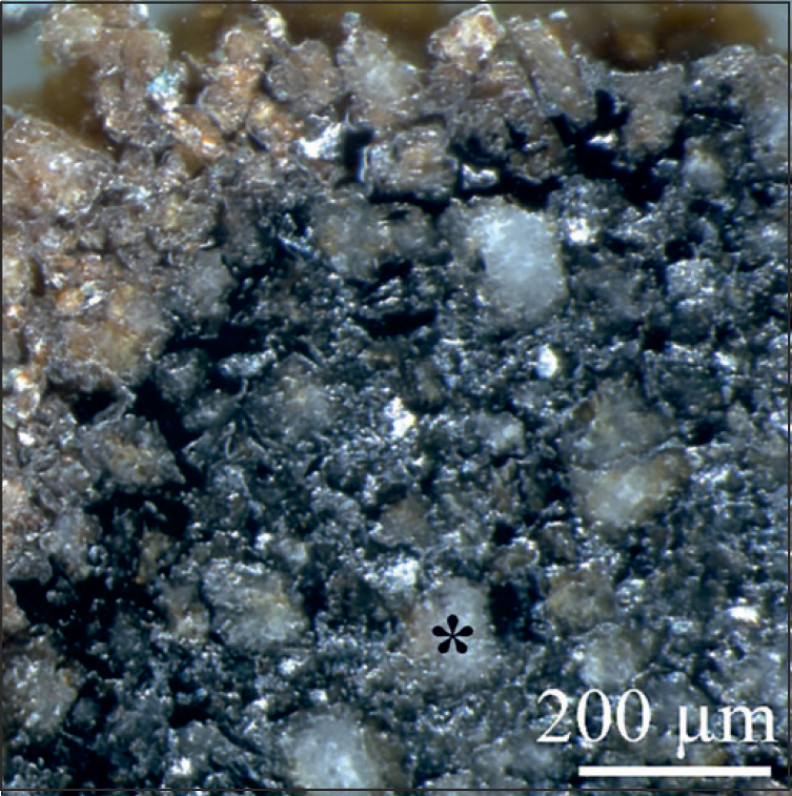
A manganese- and iron-bearing mineral assemblage occurring in Upper Triassic dolostone near Királyszentistván (Transdanubian Range, Hungary) was investigated in order to characterise the mineralogical composition and to reveal the textural relations on the micrometre scale, thereby contributing to a better understanding of the geological processes yielding these manganese oxides, partially covered by yellowish-brown goethite, occurring within vugs and cavities con­tain­ing strongly brecciated and pulverulent dolomite. To analyse the detailed mineralogical and textural features of the samples X-ray powder diffraction, scanning electron microscopy (SEM-BSE imaging, SEM-EDX point analysis and ele­mental mapping), micro-XRF elemental mapping, Raman spectroscopy and computed tomography were applied. The in­ves­tigated assemblage consists mainly of tunnel-structured manganese oxides, including romanèchite, todorokite and coronadite-group minerals, associated with goethite. Micrometre-scale observations reveal intimate intergrowths of min­er­al phases and heterogeneous element distributions, indicating multiple stages of mineral precipitation under changing redox and pH conditions. The results demonstrate that integrated mineralogical investigations, particularly high-resolu­tion textural analyses, provide essential constraints on fluid–rock interaction processes and the evolution of mineralising en­vironments. The Királyszentistván occurrence highlights the geological significance of detailed mineralogical studies of seemingly common mineral assemblages in reconstructing local geological and geochemical processes.

Author Biographies

Boglárka Anna Topa, Eötvös Loránd University

Doctoral School of Environmental Sciences, Faculty of Science

Máté Zsigmond Leskó, University of Miskolc

Institute of Exploration Geosciences, Faculty of Earth and Environmental Sciences

László Előd Aradi, Hungarian National Museum Public Collection Center

Archaeometry Laboratory, National Archaeological Institute, Hungarian National Museum

Diego Segui-Fábián, Hungarian National Museum Public Collection Center

Archaeometry Laboratory, National Archaeological Institute, Hungarian National Museum

Ágota Kazup, University of Miskolc

Institute of Physical Metallurgy, Metal Forming and Nanotechnology, Faculty of Materials and Chemical Engineering

Ferenc Kristály, University of Miskolc

Institute of Exploration Geosciences, Faculty of Earth and Environmental Sciences

Délia Bulátkó-Debus, University of Miskolc

Institute of Exploration Geosciences, Faculty of Earth and Environmental Sciences

Tamás Weiszburg, Eötvös Loránd University

Department of Mineralogy, Institute of Geography and Earth Sciences, Faculty of Science

Norbert Zajzon, University of Miskolc

Institute of Exploration Geosciences, Faculty of Earth and Environmental Sciences 

Published
2026-06-22
How to Cite
TopaB. A., LeskóM. Z., AradiL. E., Segui-FábiánD., Kazup Ágota, KristályF., Bulátkó-DebusD., WeiszburgT., & ZajzonN. (2026). Manganese oxide mineralisation hosted in Upper Triassic dolostone near Királyszentistván, Hungary. Földtani Közlöny, 156(2), 99. https://doi.org/10.23928/foldt.kozl.2026.156.2.99
Section
Articles